
Gen AI for SMBs
From vibe-coded idea to live product in days
The Digimasters Vibe Coded PoC to Scaled Product process: fewer apps, better ones, value sooner.
The overview · 3 min 9 s
From a laptop to the whole studio, in days, not months.
Captions are on by default. The people in the video are AI-generated characters and the carbon figures are illustrative.
What's changed
Gen AI has made building software almost free.
Someone in your business has probably already built something useful. What's scarce now is the judgement to know which ideas deserve to be built properly, and the speed to get the good ones paying back.
The problem
Most AI pilots never pay back.
95%
of enterprise generative AI pilots showed no measurable return
MIT NANDA, The GenAI Divide: State of AI in Business 2025
30%
of generative AI projects predicted to be abandoned after proof of concept by the end of 2025
80%+
of AI projects fail, about twice the rate of other IT projects
A hundred unsupported apps isn't an innovation strategy. It's a maintenance bill.
Our view
Quality over quantity. Value sooner.
- 01
Back the right idea.
Every idea gets a fair hearing within a day. Only the ones with a real case go forward.
- 02
Build it properly.
The right architecture for the job, secured and tested, so it lasts and can hold real data.
- 03
Get it live early.
Every week a good idea waits is value you never get back. Ship in days, then measure it.
The story
One useful idea.

An architect asks an AI assistant for a quick tool to test the embodied carbon of her scheme. By the afternoon, it works.
“That's brilliant. Can I use it on my project? And could we put the client's data in it?”
Her colleague
“I don't know. But if you think there's value in this, we can find out.”
The architect
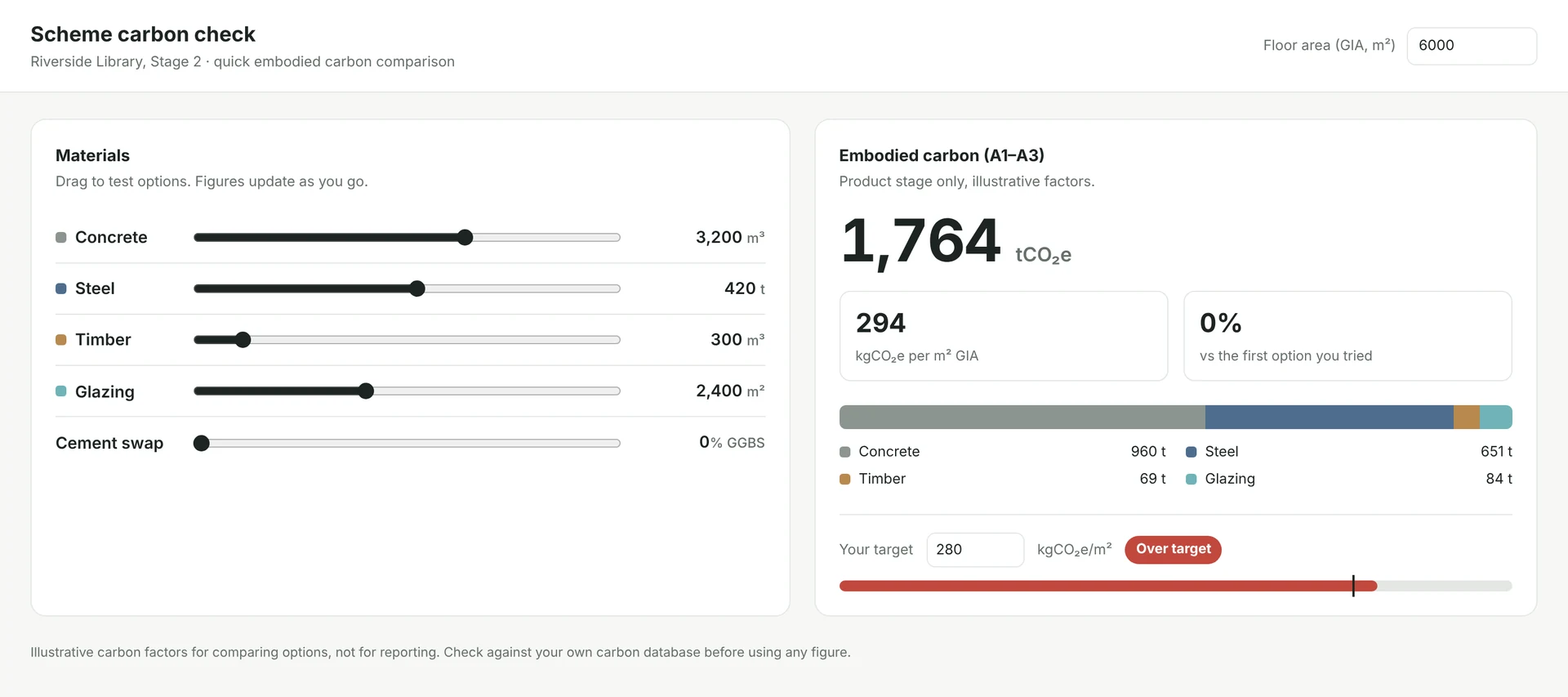
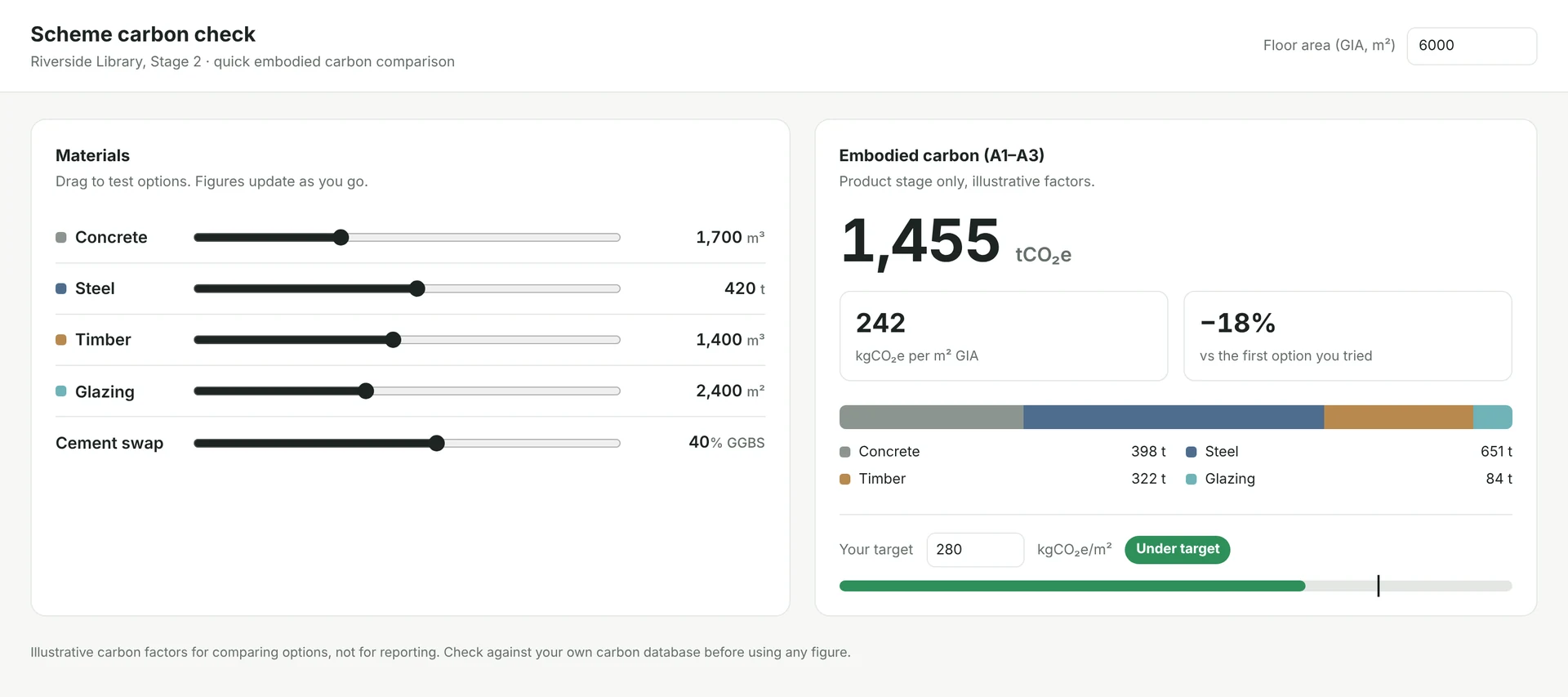
Illustrative figures.
That proves the idea is real. Not that it's ready for every project, or for client data.
Try the tool she built
Illustrative demo with made-up carbon factors. Drag the materials and watch the total move.
The route
Typically 3 to 7 working days, end to end.

Spark
An employee builds a working idea with an AI tool (Copilot, Claude Code, Codex), inside your AI policy
Assess
Uploaded to our portal, specified by AI, given a business case and scored against your priorities
Build
Secure GitHub repo, right-sized architecture, rebuilt to scale with SSO and tests
Secure
Scanned, behind Cloudflare, pen tested, and checked for privacy and accessibility
Ship & scale
Tested by your team, approved, live on secure hosting, and measured against the business case
Target timings for a departmental tool. Larger or higher-risk apps take longer.
See it work · 70 s
Every step, from upload to live.
The full 14-step process
Open full size (opens in a new tab)
Scroll sideways to follow the whole diagram.
Quality
Quality is the gate.
- After Assess
Go, rework or park
Your decision group weighs the case within 24 hours. Rework goes back to the employee with clear feedback.
- After Secure
Security sign-off
Fix, retest, then release. Nothing touches client data until it has passed.
- Before go-live
Production approval
An owner, support and a run budget are agreed before anything goes live.
Most ideas won't make it through, and that's the point.
Right-sized, rebuilt to scale
- A private, protected GitHub repository from day one
- An architecture review deciding between a single page and three tiers (front end, API, database)
- Single sign-on, automated tests, CI/CD and infrastructure as code
- Simple tools can stay single-page and skip the rebuild
Nothing goes live without sign-off
- Automated scans of code, dependencies and secrets
- Cloudflare in front (WAF, Zero Trust, DDoS and DNS)
- A penetration test against the staging build
- A data and privacy check covering DPIA, GDPR and accessibility

Hosting
It runs where it suits you.
Vercel
Rapid prototyping
- Front end
- Next.js or static site
- API layer
- Vercel Functions
- Database
- Postgres via Marketplace (Neon)
- Identity and secrets
- Auth.js, Clerk or Entra ID
Railway
Rapid prototyping
- Front end
- Static site or container
- API layer
- Containers (Node, Python)
- Database
- One-click Postgres or Redis
- Identity and secrets
- Your identity provider and environment variables
Microsoft Azure
Enterprise, M365 clients
- Front end
- Static Web Apps or App Service
- API layer
- Container Apps and API Management
- Database
- Azure SQL or PostgreSQL
- Identity and secrets
- Entra ID and Key Vault
AWS
Enterprise
- Front end
- Amplify, or S3 and CloudFront
- API layer
- API Gateway with Lambda or ECS
- Database
- RDS, Aurora or DynamoDB
- Identity and secrets
- Cognito and Secrets Manager
Cloudflare sits in front of every lane, and every change gets a preview or staging environment before it goes live.
Digimasters AI Training Academy
The judgement behind all of it.
How to spot an idea worth backing, make the case, and own a product rather than just prompt one into existence.
Five modules
- Gen AI literacy and safe vibe coding
- Writing a business case for an idea
- From citizen developer to product owner
- Secure-by-design habits
- Measuring value and adoption
Roles
Who does what.
- Your employee
- Builds the first version, makes the business case, tests it and owns the product once it’s live
- Your decision group
- Decides go, rework or park within 24 hours, and gives production approval
- Your IT or security lead
- Owns the AI use policy, chooses the hosting lane and signs off security with us
- Digimasters
- Runs the portal, writes the specification, scores the idea, rebuilds it, secures it, hosts it and measures it
Getting started
Your first month Indicative
- Week 1
Set up
AI use policy agreed, portal and decision group in place, hosting lane chosen
- Week 2
First ideas in
Uploaded, specified and scored, first go decisions
- Week 3
Build and secure
- Week 4
Live and measured
Talk to us
Fewer apps. Better ones.Value sooner.
That’s how Gen AI actually pays back.